✨ Work in Progress — We're continuously adding new content and improving CryptoMatters to help you protect your digital assets.

More Info
CryptoMatters Personnel with Computer Notebook

Chapter 08: My Crypto Exchange Journey: Learning to Better Protect My Assets

Lessons From Using a Crypto Exchange

Manuscript Date: 1 September 2026
Published: 2
 September 2026
Updated: 28
 September 2026

Greetings, beautiful people. 😊☕

Like many people entering the world of cryptocurrency, my journey started with a crypto exchange.

It was simple, convenient, and honestly quite exciting.

After creating my account, completing the necessary verification steps, and buying my first crypto, I finally felt like I had stepped into the world of digital assets.

Everything seemed straightforward.

With just a few clicks, I could buy cryptocurrencies, monitor my portfolio, and withdraw funds whenever I wanted. For a beginner, it almost felt like using an online banking app—only with a lot more colourful price charts!

At that stage, I never really questioned where my crypto was being stored. My coins were sitting safely in my exchange account, and everything appeared to be working exactly as it should.
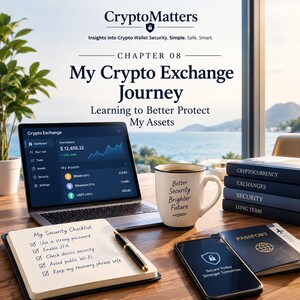
CryptoMatters Learning to better protect cryptocurrency assets through an exchange journeyThen, as I continued reading and learning about cryptocurrency, I started coming across news reports about exchanges being hacked, users falling victim to phishing scams, and even well-known exchanges collapsing unexpectedly.

I remember thinking to myself, “What if that happened to the exchange I’m using?”

Those stories didn’t make me panic, but they certainly made me pause.

They reminded me that while exchanges are incredibly convenient, they are not completely free from risk. That was the moment I began looking more seriously at how I could better protect my crypto.

I started asking myself a few simple questions.

  • What happens if my account is compromised?

  • What happens if I accidentally click on a fake website?

  • What happens if someone somehow gets hold of my password?

Instead of waiting until something went wrong, I decided it was better to develop good security habits early.

Here are some of the changes I made.
#H2> 🔐 I Started With My Password

The first thing I reviewed was my password. It wasn’t terrible, but it certainly could have been better.

I created a stronger, unique password that wasn’t used anywhere else. If one website experiences a data breach, I certainly don’t want criminals trying that same password on my exchange account.

A password manager also made life much easier. Rather than remembering dozens of complicated passwords, I only needed to remember one master password.

#H2> 🛡️ Then I Enabled Two-Factor Authentication (2FA)

The next thing I did was enable two-factor authentication.

At first, I thought the extra verification step might become annoying. After using it for a while, I realised it only takes a few extra seconds but adds a significant layer of protection.

I’ve come to think of it this way:

  • A password locks the front door.

  • Two-factor authentication adds a second lock.

If someone manages to get through the first one, they still have another obstacle waiting for them.

#H2> ⚙️ I Explored the Exchange’s Security Features

One thing that surprised me was how many security features were already available.

Some exchanges offer:

  • Withdrawal address whitelisting

  • Anti-phishing codes

  • Login notifications

  • Device management

  • Withdrawal confirmations

Many of these features only take a few minutes to configure. It’s a bit like buying a new car. We remember to wear the seatbelt, adjust the rear-view mirror, but sometimes forget to adjust the side mirrors. They are small steps that help keep us safe. 

#H2> 💻 I Paid More Attention to My Computer and Phone

Eventually, I realised something important.

My exchange account could only be as secure as the devices I used to access it. That meant keeping my computer and phone updated, avoiding suspicious downloads, and thinking twice before logging into financial accounts over public Wi-Fi.

Public Wi-Fi can be perfectly useful for everyday things. Free airport Wi-Fi is wonderful for checking the weather. But accessing a financial account is another matter entirely. 😄

Moving your crypto? Perhaps that’s a task better saved for when you’re back on a trusted network.

#H2> 🎣 I Became More Cautious About Phishing Scams

The more I learned, the more I realised that many successful attacks don’t begin with brilliant hackers breaking through complicated security systems.

  • They begin with a convincing email.

  • Or a fake website.

  • Or a message pretending to be customer support.

Now, whenever I receive an unexpected email asking me to log in or “verify” my account, I slow down and check carefully before clicking anything. Sometimes, taking an extra ten seconds can save a great deal of trouble later.

#H2> 🏦 I Stopped Treating Exchanges as Permanent Storage

Perhaps the biggest lesson I learned was this. A cryptocurrency exchange is an excellent place to buy, sell, and trade crypto.

But that doesn’t necessarily mean it’s the best place to store everything forever.

Many experienced crypto users keep only the amount they need for trading on an exchange while moving their long-term holdings elsewhere. That idea made a lot of sense to me.

For those long-term holdings, a hardware wallet can provide another approach to keeping crypto under your own control.

#H2> 🔄 Security Became a Habit, Not a One-Time Task

Over time, I found myself checking my login history occasionally, reviewing my security settings, and keeping up with new scams that were circulating in the crypto community. None of these habits are particularly difficult. Together, however, they create multiple layers of protection.

And in crypto, good security is usually built from many small habits rather than one perfect solution.

#H2> 🧭 Final Thoughts

Looking back, I’m glad my crypto journey started with an exchange. It was the easiest way for me to learn, gain confidence, and become familiar with how cryptocurrency works.

  • At the same time, I also learned that convenience should never replace good security habits.

The more I understood about cryptocurrency, the more I realised that protecting my assets was just as important as buying them.

That curiosity eventually led me to another topic that many long-term crypto holders talk about—self-custody. My earlier chapter, “Not Your Keys, Not Your Coins,” explores why controlling the keys to your crypto can matter so much.

After learning how to better protect my exchange account, my next question naturally became:

If I plan to hold crypto for years instead of days, what is the safest way to store it?

That question marked the beginning of the next stage of my crypto journey.

A Cup of Crypto Wisdom ☕

Sometimes, protecting your crypto isn’t about doing something complicated. It is about developing a few good habits—and actually remembering to use them.

A strong password, two-factor authentication, careful browsing, and a little healthy suspicion can go a surprisingly long way.

In crypto, a few extra seconds of caution can be worth far more than a few seconds of convenience.

📖 The journey continues — follow it in order, or follow your curiosity. No examination awaits you at the end — only better decisions. 😊

Facebook
LinkedIn
WhatsApp
Picture of — CryptoMatters

— CryptoMatters

I write about the often-confusing world of crypto, making it easier to understand through practical insights for everyday users. I believe protecting your digital assets shouldn’t require you to understand all the technology behind them.