

Chapter 13: How to Choose a Hardware Wallet
The Questions to Ask Before Making Your Choice
Manuscript Date: 1 September 2026
Published: 29 September 2026
Updated: 29 September 2026
Greetings, beautiful people. 😊☕
Welcome back to another CryptoMatters educational journey.
If you have been following this educational journey, welcome back. If this is your first visit, welcome — you have arrived at a good place to begin learning about crypto self-custody.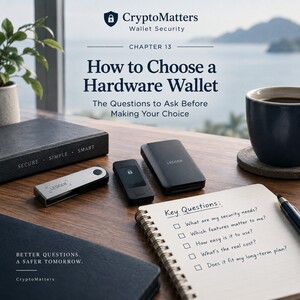
You have compared different hardware wallets.
You have explored what actually makes a hardware wallet secure.
You now understand that security is not created by one impressive specification, one large screen or one expensive price tag.
So, naturally, the next question is:
“Now that I understand the important security principles, how do I choose the right hardware wallet for me?”
That is the question I want to explore in this Chapter.
Choosing a hardware wallet is often presented as though there must be one universal winner.
The most expensive device must be the best.
The largest screen must be the safest.
The newest model must automatically be the right choice.
The device with the longest list of features must surely win.
But self-custody is not a beauty contest between specification sheets.
A hardware wallet is a tool. And like any tool, I believe the right choice depends partly on what I actually intend to do with it.
A person who uses a tool once a year may have different priorities from someone who uses it every day.
A person who travels frequently may have different needs from someone who keeps their device securely at home.
A long-term holder may prioritise simplicity.
A frequent user may value a more comfortable interface and easier transaction verification.
A mobile user may care more about convenient connectivity.
A beginner may prefer a device that feels clear and understandable rather than one filled with features they may never use.
So, before asking:
“Which hardware wallet is the best?”
A better question is:
“What do I actually need from my hardware wallet?”
That is where my decision should begin. This is the natural continuation of the mindset I explored in the previous Chapter, “The Mindset Behind Choosing a Crypto Wallet: Why ‘The Best’ May Not Be Right for Me.”
That article explored the layers that contribute to hardware-wallet security, including private-key protection, device protection, PIN protection, recovery-phrase security, transaction verification, trusted software and careful user behaviour.
It also highlighted an important principle:
A larger screen does not automatically mean greater security.
A higher price does not automatically mean better protection.
More features do not automatically make a device safer.
And a simpler device is not automatically inferior.
The same principle applies when choosing a hardware wallet.
The goal is not to find the device with the longest specification list. The goal is to find a device whose security, functionality and usability fit your actual needs — and help you practise self-custody carefully, confidently and consistently.
☕ In other words, the best hardware wallet is not necessarily the one that wins the specification-sheet Olympics. It may simply be the one you can use properly.
#H2> 🧠 A Small Note About Repetition
Because this is a beginner-friendly, long-form educational article, some important ideas may appear more than once.
If you notice that certain points seem familiar as you continue reading, please be assured that this is intentional.
Learning something important once does not always mean remembering it forever.
Sometimes, a point needs to appear again from a slightly different angle before it truly settles in.
In this article, repeated reminders about security, personal responsibility, recovery and choosing according to your actual needs are intentional.
Think of them as gentle reminders along the journey — not unnecessary repetition. 😊
#H2> 1. Start with My Own Needs
##H3> What Do I Actually Need from a Hardware Wallet?
Before comparing hardware-wallet models, I first need to begin with myself. This may sound obvious, but it is one of the most important steps.
Many people begin their research by looking at:
Price
Screen size
Touchscreen
Bluetooth
Battery
Storage
Appearance
Number of features
These details may all matter. But they should not necessarily be the first questions.
A better starting point is:
“How will I actually use this hardware wallet?”
Consider the following:
How much crypto do I intend to protect?
How frequently will I use the device?
Will I mainly use it at home?
Is mobile use important to me?
Do I travel frequently?
Do I need a larger screen?
Do I prefer physical buttons or touchscreen interaction?
Would a rechargeable battery be useful to me?
Do I prefer a simpler device or more advanced functionality?
Am I comfortable taking responsibility for my recovery phrase?
These questions help move the decision away from simply comparing specifications. Because a feature that is extremely useful to one person may be almost irrelevant to another.
For example:
A frequent user may appreciate a comfortable interface.
A long-term holder may prefer simplicity.
A mobile user may value convenient connectivity.
A traveller may place greater importance on portability.
A beginner may prefer an interface that feels easy to understand.
There is no universal answer that applies equally to everyone.
As the saying goes, different strokes for different folks.
▸ For me, the right hardware wallet depends on my actual needs, habits and responsibilities.
#H2> 2. Security Should Come Before Features 🔐
##H3> Should Security Be the First Question?
Yes.
Before comparing screen size, design, battery, connectivity or price, first consider the fundamental security architecture. The previous article explored this in greater detail.
When evaluating a hardware wallet, consider questions such as:
How are private keys protected?
How is sensitive information protected?
How is access to the device protected?
How are transactions approved?
How can transaction information be verified?
How does recovery work?
What responsibility do I have for protecting my recovery phrase?
These questions are more important than asking which device has the most features.
A hardware wallet may have an attractive design.
It may have a large display.
It may have a rechargeable battery.
It may offer convenient connectivity.
These features can be useful. But convenience should not replace the fundamentals of self-custody.
A useful way to think about the decision is:
Security first. Functionality second. Convenience third.
This does not mean convenience is unimportant. In fact, convenience can influence how consistently someone uses a device correctly. But convenience should support responsible self-custody — not distract from it.
The important question is not:
“Which device has the most features?”
It is:
“What security principles matter to me, and how does this device help me practise self-custody responsibly?”
That is a much better starting point.
#H2> 3. How Often Will You Use the Device?
##H3> Will You Use Your Hardware Wallet Frequently or Occasionally?
Your usage pattern can influence which features matter most to you. A person who interacts with their hardware wallet once or twice a year may have very different priorities from someone who uses it several times a week.
##H3> Occasional or Long-Term Use
A user who mainly intends to store assets for longer periods may prioritise:
Simplicity
Reliable security
Straightforward operation
Clear recovery procedures
A device that does not feel unnecessarily complicated
For this type of user, the most important question may be:
“Can I understand how to use this device properly and maintain my security responsibilities over the long term?”
The answer may matter more than having every possible feature. A device does not become a better choice simply because it has features that the owner never uses.
For me, the question is not simply how often I use the device. It is whether the way I use it makes certain features genuinely useful to me.
##H3> Frequent Use
A user who regularly:
Sends transactions
Reviews transaction information
Manages multiple accounts
Interacts with crypto applications
Uses the device across different situations
may place greater importance on:
Comfortable transaction verification
A convenient interface
Ease of use
A display that is comfortable to read
Connectivity that suits their normal workflow
This leads to an important observation:
Usability is not automatically the same as security, but good usability can support better security habits.
Why?
Because a device that is unpleasant to use may encourage people to rush.
A person who finds transaction review difficult may be more tempted to click through quickly.
A person who finds the interface confusing may become less attentive.
A person who finds the device convenient and understandable may be more likely to use it carefully and consistently.
The goal is not to make security effortless.
The goal is to avoid unnecessary friction that discourages responsible behaviour.
#H2> 4. Screen Size and Transaction Verification 🔍
##H3> Is a Bigger Screen Better?
The answer depends on what you need.
A larger screen may provide:
More comfortable viewing
Better readability
More space for transaction information
A more comfortable interface for certain users
For someone who frequently reviews transaction information, a larger display may be particularly appealing. However, a larger screen does not automatically make a hardware wallet more secure.
This is an important distinction.
A larger screen may improve usability and transaction review. It does not automatically create stronger security.
The better question is:
“Will a larger screen help me verify transactions more comfortably?”
rather than:
“Does a larger screen automatically make the device safer?”
The answer may be different for different people.
Someone who frequently interacts with their device may value a larger display.
Someone who uses the device occasionally may consider a smaller display perfectly adequate.
The important point, for me, is that screen size should be evaluated according to how I intend to use the device.
A larger screen can be useful. But useful does not automatically mean more secure. This distinction was one of the important lessons I took from the previous Chapter.
#H2> 5. Touchscreen or Physical Buttons?
##H3> Which Interface Is Better?
This is partly a matter of personal preference.
Some users may prefer:
Physical buttons
Tactile feedback
A simple interface
A more traditional interaction method
Other users may prefer:
Touchscreen interaction
A larger visual interface
More visual information
A more modern interaction style
Neither approach is automatically the universal winner.
A touchscreen is not automatically safer simply because it is newer.
Physical buttons are not automatically safer simply because they are more traditional.
The important question is:
“Which interface allows me to use the device confidently and verify what I am approving?”
A user who prefers physical buttons may feel more comfortable with that style.
Another user may find touchscreen interaction clearer and more intuitive.
Both users can make a thoughtful choice. For me, the interface should help me understand what I am doing. That matters because hardware-wallet security is not only about the device. It also involves the person using it.
▸ The best interface is not necessarily the most modern one. It is the one you can use carefully and confidently.
#H2> 6. Do You Need Bluetooth? 📱
##H3> Connectivity Should Match Your Actual Habits
Connectivity is primarily a question of functionality and convenience.
A person who frequently uses a mobile device may value convenient wireless connectivity.
Another person may prefer a traditional wired connection.
Neither preference automatically makes one user more security-conscious than the other.
The important questions are:
How do I normally use crypto?
Is mobile use important to me?
Will convenient connectivity make my normal workflow easier?
Will that convenience encourage me to use the hardware wallet consistently?
Bluetooth should not automatically be treated as:
Automatically unsafe
Automatically superior
It should be evaluated in context. A feature is not automatically good or bad simply because it exists.
The more useful question is:
“Does this connectivity option suit the way I actually use my hardware wallet?”
For one user, the answer may be yes.
For another, it may be no.
That is perfectly reasonable.
Connectivity is a feature. For me, it should be evaluated according to my actual habits and needs.
#H2> 7. Does an Extra Battery Matter? 🔋
##H3> Do You Need an Extra Rechargeable Battery?
Some hardware wallets may offer an additional rechargeable battery feature that allows the device to operate without being connected to a power source.
This is different from any battery that may already be included as part of the device when you purchase it. The question here is whether having an additional rechargeable battery feature would genuinely be useful to you.
It may support:
Portability
Mobile use
Convenience
Certain usage situations
However, an extra battery is not automatically a security feature. This is an important distinction.
A feature can be useful without directly increasing the security of private keys.
So ask yourself:
“Will I genuinely benefit from having an extra rechargeable battery?”
If I mainly use my hardware wallet at a desk, an extra battery may be less important to me.
If I value portable or mobile use, it may be more useful to me.
There is no contradiction.
An extra battery can be a valuable feature for one person and an unnecessary feature for another.
The same principle applies to many hardware-wallet features.
A feature can be useful without being a security feature.
This is why simply counting features is not always a useful way to compare devices.
#H2> 8. Portability and Lifestyle
##H3> Will I Travel with My Hardware Wallet?
My lifestyle may influence my decision.
Some users may:
Keep their hardware wallet securely at home
Store it in a safe location
Carry it while travelling
Use it across different locations
Portability may therefore matter. However, portability also introduces additional responsibility.
If you travel with a hardware wallet, consider:
Physical security
Privacy
Where the device is stored
Where the recovery phrase is stored
Whether carrying the device is genuinely necessary
One particularly important principle is this:
Your hardware wallet and your recovery phrase should not simply travel together as though they were a matching pair.
The recovery phrase is extremely sensitive information.
Anyone who obtains the recovery phrase may potentially gain access to the assets associated with it.
Therefore, unnecessary exposure of both the device and the recovery information should be avoided.
If someone has access to both, the situation can become particularly serious.
This is why a hardware wallet is only one part of a broader self-custody plan. You must also think carefully about backup and recovery responsibilities. Travelling with the device may be convenient. But convenience should be balanced against physical security and privacy.
#H2> 9. How Much Simplicity Do You Want?
##H3> Is a Simpler Hardware Wallet Better?
Not automatically.
A simpler device may be attractive to someone who wants:
Fewer distractions
Straightforward operation
A simple interface
Less complexity
Another user may genuinely need:
More advanced functionality
Greater convenience
More frequent interaction
A richer user experience
Neither user is automatically making the better decision.
The important question is:
“Which features will I genuinely use?”
A feature that is never used does not automatically add value simply because it appears on a specification sheet.
This brings us back to a lesson from the previous article:
A simpler device is not automatically inferior.
A simpler device may be exactly what one user needs.
A more advanced device may be exactly what another user needs.
The important thing is to match the device to the user. Not the other way around.
#H2> 10. Price and Value
##H3> Is the Most Expensive Hardware Wallet the Best?
No.
Price may reflect various factors, including:
Hardware design
Display technology
Materials
Connectivity
Battery
Additional features
Product positioning
However:
A higher price does not automatically mean a device is the best choice for every user.
This is where the difference between price and value becomes important.
##H3> Price
Price is:
How much the device costs.
H3> Value
Value is:
How useful the device is for your specific needs.
These are not the same thing.
A more expensive device may offer excellent value to one person because that person genuinely uses its features.
A less expensive device may offer better value to another person because it provides everything they actually need.
There is no contradiction.
As the saying goes, one man’s meat is another man’s poison.
A feature that one person considers essential may be completely unnecessary to someone else.
For example:
A frequent user may genuinely value a more comfortable interface.
A mobile user may value convenient connectivity.
A long-term holder may not need many additional features.
The question should therefore be:
“Am I paying for features that I genuinely need?”
And also:
“Will this device help me practise self-custody more effectively?”
The most expensive option may be the right choice for one person. It may be unnecessary for another. Value depends partly on the user’s needs.
#H2> 11. Frequency of Transactions and User Behaviour
##H3> Your Behaviour May Matter More Than the Specification Sheet
One of the most important questions to ask is:
“How will I actually behave when using this hardware wallet?”
Consider:
Do I make transactions frequently?
Do I regularly review addresses?
Do I interact with decentralised applications?
Do I mainly hold assets?
Do I want to use the device occasionally?
Will I take the time to verify transactions carefully?
A user who makes frequent transactions may place greater importance on:
Comfortable transaction review
Ease of interaction
Convenient access
A clear interface
A long-term holder may place greater importance on:
Simple operation
Secure storage
Recovery planning
Long-term confidence
Neither user is automatically right or wrong. They simply have different requirements.
This is why the ideal hardware wallet can differ between individuals.
The best device for someone who makes frequent transactions may not be the best device for someone who rarely interacts with their wallet.
The best device for someone who travels frequently may not be the best device for someone who keeps everything securely at home.
The best device for an experienced user may not be the best device for a beginner.
There is no accounting for taste — and there is no single hardware-wallet experience that will suit every user equally.
▸ The best device is not necessarily the device with the most capabilities. It is the device that fits your actual behaviour.
#H2> 12. The Recovery Phrase Should Influence Your Decision ⚠️
Choosing a hardware wallet also means accepting responsibility for the recovery phrase.
This is one of the most important parts of self-custody.
Before choosing a device, you should understand that:
The recovery phrase is critical.
The hardware wallet can be replaced.
The recovery phrase must remain private.
The recovery phrase should never be entered into suspicious websites.
The recovery phrase should not be casually stored online.
A recovery plan should exist.
The hardware wallet is only one part of a broader self-custody plan.
I should also think about:
Where my recovery information will be stored.
Who, if anyone, should eventually have access.
What happens if my device is lost.
What happens if my device becomes unusable.
What happens if I become unavailable.
These questions connect naturally to earlier CryptoMatters educational content about:
Crypto Estate Planning
Beneficiary Access
Emergency Recovery Plans
Inheritance Risks
A hardware wallet may help you protect your digital assets today. But responsible self-custody also involves thinking about tomorrow.
What happens if something unexpected occurs?
What happens if you cannot access your device?
What happens if someone you trust needs to understand how your digital assets are intended to be handled?
These are questions designed to encourage responsible planning.
🔐 The hardware wallet protects only part of the system. Your recovery plan, security habits and long-term planning also matter.
#H2> 13. A Practical Decision-Making Framework 🧭
If I am still unsure how to choose, I can use the following five-step framework.
##H3> 👣 Baby Step 1 — Identify Your Main Use
Ask:
“What will I mainly use this hardware wallet for?”
Possible answers include:
→ Long-term holding
→ Frequent transactions
→ Mobile use
→ Travel
→ Occasional use
Your main use will help determine which features deserve your attention.
##H3> 👣 Baby Step 2 — Identify the Features You Actually Need
Now consider:
→ Screen size
→ Interface
→ Connectivity
→ Battery
→ Portability
→ Simplicity
Do not ask:
“Which device has more features?”
Ask:
“Which features will I genuinely use?”
That question is much more useful.
##H3> 👣 Baby Step 3 — Consider Security Fundamentals 🔐
Before making a decision, consider:
→ Private-key protection
→ Device security
→ PIN protection
→ Recovery
→ Transaction verification
For me, those security fundamentals should remain central to the decision, and a beautiful device with impressive features is still no substitute for understanding my security responsibilities.
##H3> 👣 Baby Step 4 — Consider Your Own Habits
Ask yourself:
→ Will I verify transactions carefully?
→ Will I protect my recovery phrase?
→ Will I use the device consistently?
→ Will I take the time to understand what I am approving?
This step is important because the user is part of the security model.
A device can provide security features.
But the owner still has responsibilities.
##H3>👣 Baby Step 5 — Consider Long-Term Suitability
Finally, ask:
→ Will the device still suit my needs later?
→ Is it convenient enough for me to use?
→ Am I buying features I genuinely need?
→ Will I remain comfortable using it?
A hardware wallet is not necessarily something you buy simply to use for a few weeks.
Your decision should therefore consider whether the device fits your expected long-term needs.
#H2> 14. Five Questions to Ask Before Choosing
If you want a simple checklist, begin here.
##H3> 💭 Question A — What Am I Actually Using the Hardware Wallet For?
Am I mainly holding assets?
Am I making frequent transactions?
Am I using mobile devices?
Am I travelling?
My primary use matters.
##H3> 💭 Question B — How Frequently Will I Use It?
A device used several times a week may have different usability requirements from one used occasionally.
##H3>💭 Question C — Which Features Genuinely Matter to Me?
Do I genuinely need:
A larger screen?
Touchscreen interaction?
Wireless connectivity?
A battery?
Greater portability?
Additional functionality?
Do not pay for features simply because they exist.
##H3> 💭 Question D — Can I Comfortably Verify Transactions?
Transaction verification is an important part of responsible self-custody.
I should choose an experience that allows me to review what I am approving carefully.
##H3> 💭 Question E — Am I Prepared to Take Responsibility for the Recovery Phrase?
This may be the most important question of all.
A hardware wallet is not a magic box that removes responsibility from the owner.
Self-custody means taking responsibility for protecting the information that allows access to your assets.
#H2>15. A Simple Comparison Approach
When comparing hardware wallets, avoid simply counting specifications. Instead, compare the areas that matter to your actual needs.
Area | Question |
|---|---|
Security | How are private keys protected? |
Verification | Can I comfortably review transactions? |
Usability | Will I actually use the device properly? |
Connectivity | Does it suit how I use crypto? |
Portability | Does my lifestyle require it? |
Recovery | Do I understand my backup responsibilities? |
Value | Am I paying for features I genuinely need? |
This approach is often more useful than asking:
“Which device has the longest feature list?”
Because a long feature list does not tell you whether those features are useful to you.
A better comparison asks:
“Which device best matches my needs, habits and responsibilities?”
That is a much more meaningful question.
#H2> 16. What If I Still Cannot Decide?
Feeling uncertain is normal. Hardware wallets involve security, money and personal responsibility. It is understandable to want to make a thoughtful decision.
But you do not need to know every technical detail before making a reasonable choice.
If I am still unsure how to choose, I can simply return to the basics.
Begin with the basics.
Ask:
What is my main use?
What features do I genuinely need?
What security responsibilities am I prepared to manage?
Which device feels clear and comfortable enough for me to use responsibly?
Choosing a hardware wallet is not an examination where there is only one correct answer.
There is no special certificate waiting at the end of the specification sheet.
You do not need a PhD in cryptography before choosing a hardware wallet. ☕
You do, however, need to understand the importance of protecting your recovery phrase.
That particular piece of information is not especially impressed by academic titles. 😄
The goal is not to become an expert in every technical detail.
The goal is to understand enough to make a thoughtful decision and use the device responsibly.
#H2> 💡 A Helpful Way to Think About It
Imagine that you are choosing a pair of shoes.
A person who walks long distances every day may want something different from someone who wears shoes occasionally.
A person who travels may prioritise comfort and portability.
A person who attends formal events may care more about appearance.
There is no single pair of shoes that is automatically the best for every situation.
Hardware wallets are obviously far more important than shoes.
Please do not store your recovery phrase in your shoes.
But the principle is similar.
The best choice depends partly on:
What you will use it for
How often you will use it
Which features matter to you
What responsibilities you are prepared to manage
The most expensive option is not automatically the best.
The simplest option is not automatically the worst.
The newest option is not automatically the right option.
For me, the best choice is the one that fits my actual needs.
#H2> 🏁 Conclusion: Choose the Hardware Wallet That Fits Me
Choosing a hardware wallet should not begin with:
“Which one has the most features?”
It should begin with:
“What do I actually need?”
A thoughtful decision considers:
Security fundamentals
Private-key protection
Transaction verification
Recovery responsibilities
Frequency of use
Interface preferences
Connectivity
Portability
Convenience
Personal habits
Long-term suitability
The most expensive device is not automatically the best.
The device with the largest screen is not automatically the safest.
The device with the most features is not automatically the most suitable.
And the simplest device is not automatically inferior.
The best hardware wallet is the one whose security, functionality and usability fit your actual needs — and help you practise self-custody carefully, confidently and consistently.
That is the real goal.
Not to win a specification-sheet competition.
Not to purchase the most expensive device simply because it is the most expensive.
Not to choose a device because someone on the internet declared it to be the universal winner.
Instead, ask yourself:
“What am I protecting?”
“How will I use the device?”
“Which features genuinely matter to me?”
“Can I use it carefully and consistently?”
“Am I prepared to take responsibility for my recovery phrase?”
These questions will lead to a much more thoughtful decision.
We have now explored how to choose a device according to:
Security fundamentals
Personal needs
Usage patterns
Transaction verification
Connectivity
Portability
Convenience
Recovery responsibilities
Long-term suitability
A Cup of Crypto Wisdom ☕
The right wallet is not the one that impresses me the most. It is the one I understand, can use responsibly, and can live with confidently.
☕ The journey continues.

— CryptoMatters
I write about the often-confusing world of crypto, making it easier to understand through practical insights for everyday users. I believe protecting your digital assets shouldn’t require you to understand all the technology behind them.