

Chapter 14: How I Choose a Crypto Wallet: The Qualities I Don't Want to Compromise On
My Personal Checklist for Choosing a Wallet
Manuscript Date: 1 September 2026
Published: 30 September 2026
Book Revamp: 5 October 2026
Greetings, beautiful people. 😊☕
After going through the earlier chapters of this journey, I have come to realise something quite simple:
Choosing a crypto wallet is not really about finding the wallet with the longest list of features.
It is about deciding which qualities matter enough to me that I am not willing to compromise on them.
That may sound like a small distinction, but I think it changes the entire way I look at a crypto wallet. 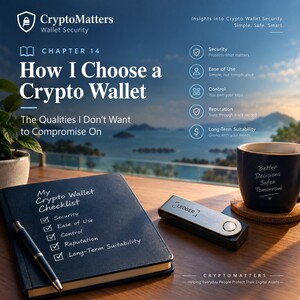
There will always be another wallet.
Another model.
Another feature.
Another review claiming that something is “the best.”
But ultimately, the wallet is going to hold something that belongs to me. So perhaps the more important question is not:
“Which wallet is the best?”
but:
“Which qualities do I personally refuse to compromise on?”
That is how I approach the decision.
#H2> 1. Security Comes First
The first quality I do not want to compromise on is security.
This may sound obvious, but it is worth saying because a wallet can be beautifully designed, inexpensive, convenient and packed with features — yet none of those things matter very much if I cannot trust its security model.
For me, security means looking beyond marketing words. I want to understand
how the device protects my private keys,
how transactions are approved,
how sensitive information is handled,
and what protections exist against unauthorised access.
I do not expect any wallet to make me completely immune from mistakes. Instead, I want a wallet that helps me make fewer dangerous mistakes.
That distinction matters. A secure wallet does not remove my responsibility. It helps me carry that responsibility more safely.
#H2> 2. I Want to Remain in Control
The second quality is ownership and control.
One of the most important lessons from this entire journey has been the meaning behind:
“Not your keys, not your coins.”
If I choose self-custody, I am accepting responsibility for controlling access to my assets. That means I do not want my ownership to depend entirely on another company’s account system remaining available, another person’s permission, or my ability to recover an ordinary online account.
Self-custody gives me greater control. But greater control also means greater responsibility. That is a trade-off I need to understand before I make the decision.
#H2> 3. Recovery Must Be Taken Seriously
I do not want to compromise on recovery.
A wallet can be perfectly secure today, but what happens if the device is lost, damaged or no longer usable? That question is just as important as:
“How secure is the wallet?”
For me, a proper recovery system is essential.
The recovery phrase is not simply a series of words that I write down during setup and forget about. It represents an extremely important part of my ability to regain access to my assets. That means its creation, storage, protection and eventual recovery process all deserve serious attention.
A wallet that gives me control should also give me a sensible way to recover that control. Without that, it would not feel complete to me.
#H2> 4. I Want Clear Transaction Verification
Another quality I do not want to compromise on is the ability to verify what I am actually approving. Crypto transactions can be unforgiving.
If I approve the wrong address or an incorrect transaction, there may be no friendly customer-service button waiting to reverse my mistake. That makes transaction verification particularly important.
I want the process of confirming a transaction to be clear enough that I can stop, look carefully and ask myself:
“Is this really what I intend to approve?”
Convenience is useful.
But when convenience begins encouraging me to approve something without checking it properly, convenience becomes a weakness.
#H2> 5. I Prefer Transparency Over Mystery
I do not expect to understand every technical detail behind a hardware wallet.
But I do want the company and the product to provide enough information for me to understand the important things.
How does the wallet work?
What security architecture does it use?
How are updates handled?
What happens if something goes wrong?
What does the company expect me to do to protect myself?
The more clearly these questions are addressed, the more comfortable I become. I would rather have a company explain its limitations honestly than promise me that its product is somehow invincible. Because no wallet is invincible. And neither am I.
#H2> 6. Security Should Not Require Me to Be a Genius
This one is particularly important to me.
I want security to be strong, but I also want the user experience to be understandable. If protecting my assets requires me to become a cybersecurity engineer before I can safely operate the wallet, that creates another problem.
Good security should encourage good behaviour. It should make important actions clear. It should make dangerous actions harder to perform accidentally.
And when something deserves my attention, I want the wallet to make that reasonably obvious.
In other words: I want strong security without unnecessary confusion.
#H2> 7. I Want a Wallet I Can Actually Live With
A wallet may have excellent security on paper.
But if using it becomes so inconvenient that I constantly look for shortcuts, that can create another form of risk. I want something I can realistically incorporate into my crypto habits.
That means considering things such as:
How easy it is to set up.
How clearly transactions are presented.
How comfortable it is to use.
How it fits into my normal routine.
Whether I understand what I am doing when I use it.
The best security system is not particularly helpful if I consistently avoid using it properly because it is too frustrating.
#H2> 8. I Want the Product to Fit My Needs — Not the Other Way Around
This is where I have learned to be careful with the word “best.”
The best wallet for someone else may not be the best wallet for me.
Someone may prioritise a particular feature that I rarely use.
Another person may want maximum portability.
Someone else may care primarily about price.
Another user may prefer a particular interface.
There is nothing wrong with any of those priorities. They simply demonstrate that choosing a wallet is personal.
So instead of asking:
“What is the best wallet?”
I would rather ask:
“What do I need this wallet to do, and which qualities matter most to me?”
That question is much harder to answer. But it is also much more useful.
#H2> 9. I Do Not Want Price to Be My Only Decision-Maker
Price matters. Of course it does.
But when the purpose of a wallet is to help protect valuable digital assets, I do not want the cheapest price to automatically determine my decision.
Saving a little money on the wallet itself may not be particularly meaningful if I end up choosing something that I
do not understand,
do not trust or
do not use properly.
At the same time, more expensive does not automatically mean better.
So I want to think in terms of value, rather than simply price.
What am I receiving for what I am paying?
What security features matter to me?
What level of usability do I need?
What kind of support and ecosystem does the product provide?
Those questions are more useful than simply asking: “Which one is cheapest?”
#H2> 10. I Want a Company I Can Understand and Trust
When I buy a hardware wallet, I am not simply buying a piece of electronics. I am entering into a relationship with the company behind it.
That makes the company’s reputation,
security practices,
communication,
product development and
support important considerations for me.
I want to know that the company takes security seriously. I want information to be available when I need it.
And I want the company to recognise that users ultimately carry responsibility for their own assets.
Trust should not be based purely on advertising. It should be built through transparency, consistency and responsible behaviour over time.
#H2> 11. I Want Security to Remain Important After Purchase
Buying the wallet is not the end of the security journey.
In some ways, it is the beginning.
I still have to protect my recovery phrase.
I still have to verify addresses.
I still have to be careful about phishing attempts and scams.
I still have to keep my device and software appropriately maintained.
And I still have to think before approving transactions.
This is why I do not look for a wallet that promises to “keep me safe.” I want a wallet that gives me the tools to help keep myself safe. That difference is important.
#H2> 12. I Do Not Want Features Just for the Sake of Features
More features can look impressive. But more is not always better.
Every additional function can introduce another question:
“Do I actually need this?”
For me, a wallet should not win simply because it has the longest specification sheet. I would rather have the features that genuinely improve my security, control, recovery and everyday experience.
A shorter list of useful features can be more valuable than a long list of features I rarely understand or use.
#H2> 13. I Want My Decision to Be One I Can Explain
Perhaps this is the simplest test of all. If someone asks me:
“Why did you choose this wallet?”
I want to be able to give a sensible answer.
Not:
“Because everyone says it is the best.”
Not:
“Because it was on sale.”
And certainly not:
“Because the advertisement looked impressive.”
I want to be able to say:
“These are the qualities I consider important, and this wallet best matches those priorities.”
That is a much stronger decision. It means I chose according to my own requirements.
#H2> My Non-Negotiables
After considering everything above, my personal priorities can be simplified into a few fundamental qualities.
Security.
Control.
Recovery.
Clear transaction verification.
Transparency.
Usability.
Reliability.
A company I can reasonably trust.
A product that fits my actual needs.
And perhaps most importantly:
A wallet that encourages me to behave responsibly.
These are the qualities I do not want to compromise on. They may not be exactly the same qualities another person chooses. And that is perfectly fine.
#H2> The Wallet Is Only One Part of the Security Equation
There is one final lesson I have taken from this journey.
A hardware wallet is important. But it is not magic.
It cannot protect me from every phishing attempt.
It cannot stop me from sending crypto to the wrong address if I approve the transaction.
It cannot protect a recovery phrase that I carelessly expose.
And it cannot make an irresponsible decision become a responsible one.
Ultimately, the wallet is a security tool — not a substitute for good judgement.
That is why I believe choosing a wallet should begin with understanding myself as a user.
What am I trying to protect?
What risks concern me?
How much responsibility am I prepared to accept?
What level of convenience do I need?
And which qualities am I simply unwilling to compromise on?
Once I can answer those questions, choosing a wallet becomes a decision I can own.
#H2> My Way of Looking at the Decision
If I had to reduce the entire chapter to one thought, it would be this:
I want to choose a crypto wallet because it matches the qualities I believe matter most to me.
That is a very different mindset. And perhaps that is the real purpose of this journey.
We started by looking at what can be lost.
Then we explored ownership, recovery, inheritance, transfers, exchanges and hardware-wallet security.
We learned how to compare. We learned how to question.
And finally, we are learning how to make the decision ourselves.
That, to me, is what responsible self-custody is really about.
Not simply owning the keys. Understanding the responsibility that comes with owning them. And if I can make a wallet decision based on that understanding, I believe I have already taken one important step toward protecting my digital assets.
☕ A Cup of Crypto Wisdom
There is no universally perfect crypto wallet.
It’s about knowing what matters to you — and what you are unwilling to compromise on. The right wallet may not be the best wallet. It may simply be the one that best fits your journey.
The right choice should ultimately be one that aligns with my own needs, risk awareness, technical comfort and willingness to take responsibility for self-custody.
And that brings us naturally to the next question:
Does Ledger Meet the Standard?
Let’s examine it. 😏☕

— CryptoMatters
I write about the often-confusing world of crypto, making it easier to understand through practical insights for everyday users. I believe protecting your digital assets shouldn’t require you to understand all the technology behind them.